Hoʻokomo nā hoʻokolohua mālama ʻana o Manitoba i nā mea ʻike a me ke aʻo mīkini e hana i ka ʻike mua ʻana i ka pala
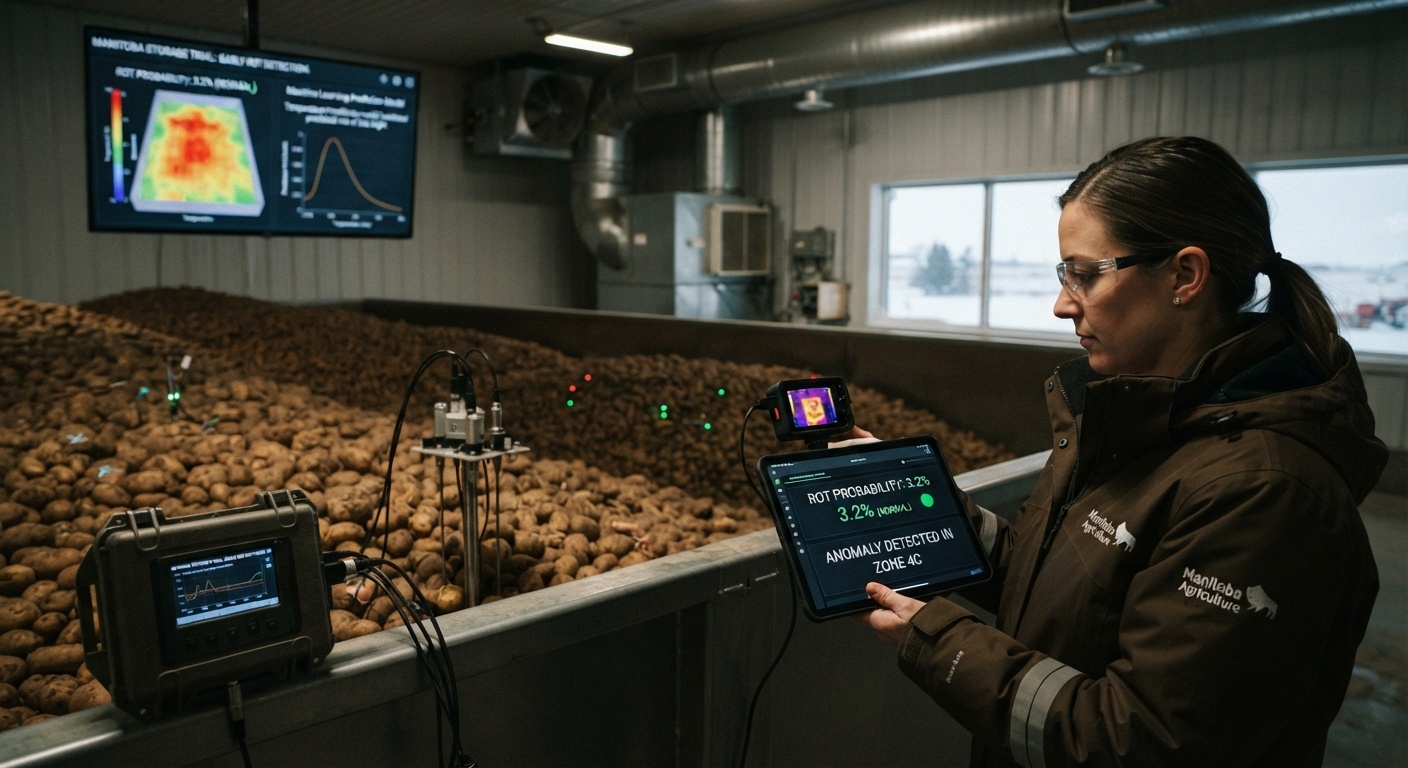
Long-term storage is often called the “second season” for potatoes, and for processing crops it is where much of the season’s value is either protected or lost. A Calgary-based agtech company, Cellar Insights, is now testing whether continuous sensor data and machine learning can flag spoilage risk in Manitoba storages before it becomes visible. The company presented its work at Agriculture Enlightened, the conference organised by EMILI in Winnipeg. It says it collects data from around 150 storages [VERIFY], but no independently verified reduction in losses has been published.
He aha ke ana
The system tracks three core storage parameters: temperature, humidity and carbon dioxide. Readings are logged every 15 to 30 minutes [VERIFY]. Low-cost, battery-powered wireless sensors are placed directly in the pile, and a hub in the facility sends the data to the cloud over a cellular connection. Growers set their own thresholds and receive alerts when conditions move outside them, and trend reports covering 24 hours, seven days and 30 days allow storages to be compared with one another.
The conventional alternative is a daily walk of the pile, a visual check and, often, a smell test. For processing potatoes, the ideal holding temperature is 8–10°C, and it has to be maintained for months to meet the requirements of chip and French fry processors.
Nā lā pule. E wehe i ke kau inoa me hoʻokahi kaomi.
Where the AI comes in
Cellar Insights compares the storage history of each facility with the quality of the tubers later delivered to processors, looking for patterns that precede deterioration. The tool is still in development. Chief executive Terry Sydoryk said in April 2026 that the aim was to equip about 100 storages with sensors and to add gas and volatile-compound sensors in a further 15 to 20. The next step is a model that predicts rot risk for an individual storage.
It is worth being clear about what this does and does not claim. The system aims to forecast the risk of spoilage so that growers can intervene early, for example by adjusting humidity. It has not yet been shown to reduce losses by a quantified amount.
Why it matters in Manitoba
Manitoba accounted for about 20% of Canada’s potato area in 2024, making it the country’s second-largest producing province, according to Manitoba Agriculture. Several seasons at the start of this decade saw storage problems cause significant losses for growers there.
The company says that even in a well-run facility around 4% of yield is lost to respiration in storage, with rot, disease and quality degradation adding to that figure [company data]. For processors, the margin for error is narrow because sugar content and fry colour must stay within tight specifications.
One of the first Manitoba partners is J.P. Wiebe Ltd. at MacGregor. Its farm is an EMILI Innovation Farms site and the first potato operation in Farm Credit Canada’s Innovation Farm Network, where the technology is tested under commercial storage conditions.
No ka hui
Cellar Insights was established in 2023 through the Calgary-based venture studio Carrot Ventures. It is headquartered in Alberta rather than Manitoba, and has also run deployments in New Brunswick and Alberta, with work under way in Prince Edward Island.
Editorial notes (not for publication)
- Machine-adapted text: written independently from the Russian version, not translated; British spelling and metric units used throughout. Please proofread before publishing.
- [VERIFY] items rest on a single source (Argenpapa). The original Spud Smart article could not be opened. Earlier reports mention about 100 storages, and the April 2026 Manitoba Co-operator piece cites a target of 100 instrumented storages, so the figure of 150 may reflect growth but is unconfirmed.
- Correction to Argenpapa: J.P. Wiebe Ltd. is the first potato operation in the Innovation Farm Network, not “one of the first in Manitoba”.
- Pākuʻi ʻole ʻia: promotional figures from the seed-round release (“up to 25% post-harvest loss”, “US$38 billion market”) and the investment amount (reported as US$500,000 by FreshPlaza and C$500,000 by Goodmans).
- Not checked: duplication on potatoes.news (JS-rendered, not fetchable). No cover image sourced.
kumu
- Argenpapa, 10 November 2026
- Manitoba Co-operator, 12 April 2026
- Farms.com, 6 January 2026
- ʻO FreshPlaza
- CTV Winnipeg
- PotatoPro, 13 September 2025
- Farms.com, Agriculture Enlightened 2026
- Spud Smart (Argenpapa’s source; could not be opened)